Media
Information

2026 / 07 / 15
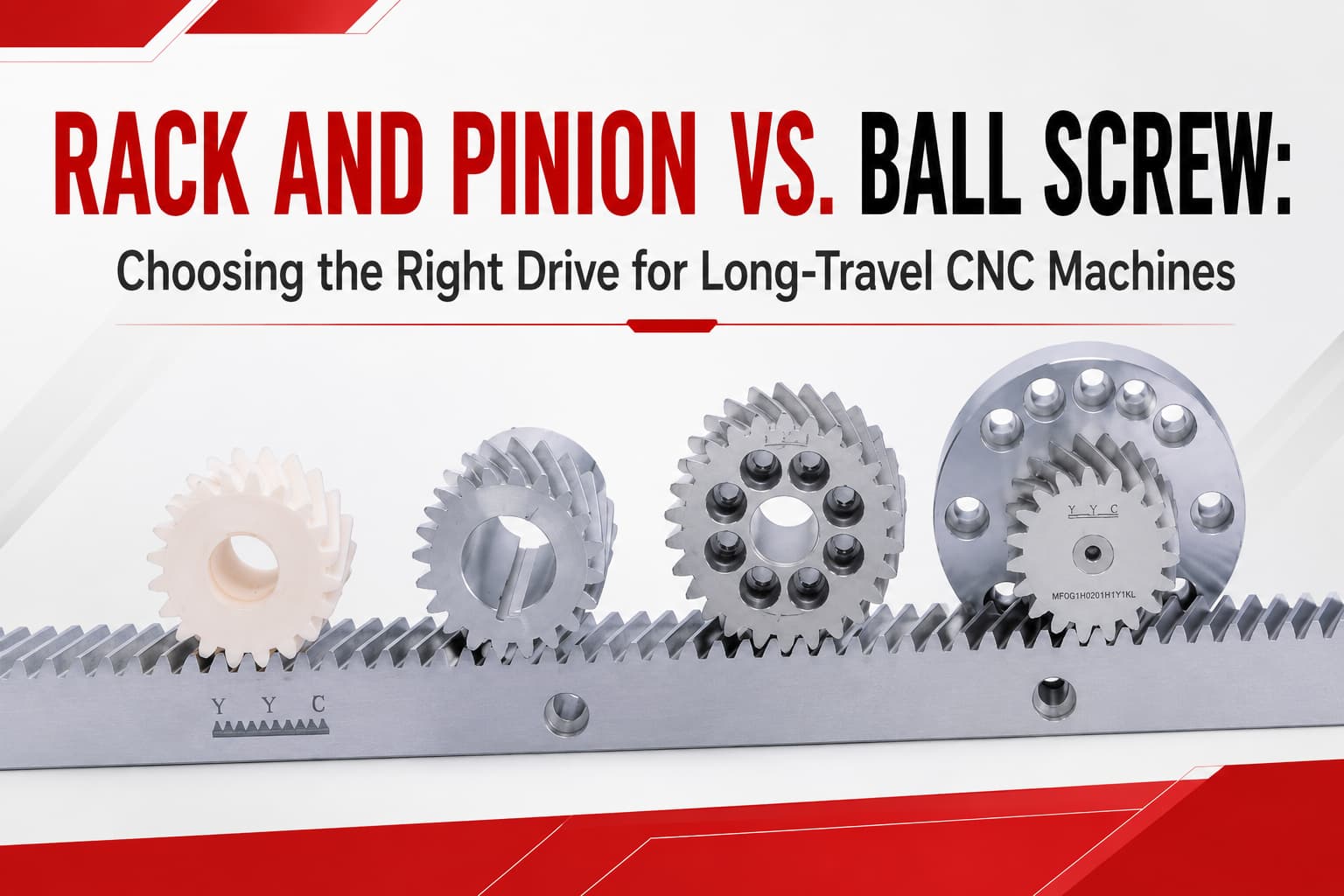
The linear drive you pick for a CNC axis shapes almost everything that follows — travel length, traverse speed, positioning accuracy, load capacity, maintenance, and ultimately how the finished machine performs. For most machine builders the choice comes down to two proven technologies: rack and pinion and ball screw.
Both deliver precise linear motion; they simply excel under different conditions. A ball screw is often the natural pick for compact axes with short travel and demanding fine-positioning. But as machines grow and axis travel stretches to several meters — large gantry machining centers, CNC routers, boring mills, laser cutters and other long-stroke equipment — rack and pinion frequently becomes the more practical solution.
YYC, a Taiwan-based manufacturer of precision drive components, supplies straight and helical precision gear racks for long-stroke CNC and industrial machinery, across a range of modules, precision grades, materials and heat-treatment options.
So which drive is right for your machine? The honest answer is: it depends on the axis — and accuracy alone doesn't decide it.
For short or moderate travel where fine positioning and compact installation matter most, a ball screw is often an excellent choice.
For long-travel axes that need high speed, rigidity, scalability and movement across several meters, rack and pinion is usually the better fit.
The core reason is physical. A ball screw drives motion by rotating a long screw shaft, and that shaft is bound by a critical-speed limit — the longer and less-supported it gets, the harder it is to spin fast without vibration and resonance. A rack is mounted along the machine structure and doesn't rotate as one long shaft; the pinion spins while traveling along it. Rack sections can also be joined end to end, which is exactly what long axes need.
A rack and pinion drive pairs a linear gear (the rack) with a rotating gear (the pinion). As the pinion turns, its teeth engage the rack to produce linear motion — either the pinion travels along a fixed rack, or the rack moves past a fixed pinion. Performance depends on the rack and pinion being properly matched, which is why YYC offers both precision racks and straight and helical cylindrical pinions designed to work together.
A ball screw converts rotary motion into linear motion through a threaded shaft, a ball nut and recirculating steel balls. Because the rolling elements cut sliding friction, ball screws handle precise movement and micro-feeding well — hence their popularity in precision positioning stages and machine-tool feed axes.
Neither is universally better. Travel length, speed, load, accuracy, environment and maintenance strategy all steer the decision.
| Selection factor | Rack and Pinion | Ball Screw |
|---|---|---|
| Long travel | Well suited to multi-meter axes | Needs care as screw length grows |
| High speed / long stroke | Strong — no full-length rotating shaft | Limited by critical speed & DN value |
| Scalability | Rack sections can be joined | Longer travel needs longer/special screw |
| Fine positioning | High precision with right grade & design | Excellent for micro-feeding & reversal |
| Large machines | Ideal for gantries, routers, boring mills | Common on shorter/medium axes |
| Backlash | Preload, dual pinion, adjustment, mounting | Preloaded nuts minimize clearance |
| Installation | Alignment & rack-joint accuracy critical | Bearing support, alignment, critical speed |
| High load | By module, material, heat treatment | High thrust when properly sized |
Treat this as an engineering starting point, not an absolute rule. A final decision should account for the real motion profile: travel, acceleration, cutting forces, duty cycle, required accuracy, rigidity and environment.
A ball screw's rotating shaft must be checked against its critical speed as it lengthens — diameter, support, length, speed and lead all interact. It can be engineered for long travel (large-lead screws, rotating-nut designs, extra supports), but that adds complexity. Rack and pinion sidesteps the problem: because the rack is fixed to the structure, you simply add more sections as the axis grows — a real advantage for OEMs building ever-larger equipment.
Pushing a ball screw to high rpm and long length compounds critical-speed, vibration, bearing-support, diameter and lead concerns — so two screws that look similar on paper may have very different permissible speeds. A rack drive rotates only the pinion, making it attractive for long axes needing fast rapid traverse — which directly cuts non-cutting time and improves cycle time on large machines.
Ball screws are well established for precise positioning, but modern precision racks come in multiple grades and support demanding applications too — YYC's precision gear racks span several grades (DIN 5, 6, 7, 8 and 10 depending on series) in modules from M1.5 to M10. Real machine accuracy is never set by the drive component alone: rack or screw accuracy, backlash or preload, mounting, joint alignment, pinion engagement, guideways, gearbox, servo, encoder feedback, thermal effects and frame rigidity all contribute. The better question isn't “which is more accurate?” but “which complete motion system holds the required accuracy across the full travel and real operating conditions?”
Excess backlash hurts positioning, reversal, contouring, surface finish and repeatability. Ball screws use preload to minimize axial clearance. Rack and pinion controls it via center-distance adjustment, spring-loaded or dual pinions, preload mechanisms, gearbox selection and precise installation. On long axes, don't judge backlash at a single point — consider how the whole drive behaves across several meters.
Large machines move heavy gantries, tables, cutting heads and columns, so static load and dynamic forces both count. Rack and pinion can be tuned through module, tooth profile, material, hardening and pinion size — YYC's machine-tool racks are available in S50C and SCM440, commonly M2 to M8 by machine size. But a bigger module doesn't automatically mean better performance: calculate the actual tangential force, acceleration, duty cycle, shock loads, required service life and safety factors. Motor, gearbox, pinion, rack, guideway, bearings and frame must work as one system.
For very long axes, modular installation is a practical win — mounting several rack sections beats manufacturing one enormous rotating screw. But mounting quality is everything: poor joint alignment causes noise, uneven tooth contact, positioning error, accelerated wear and vibration. Plan reference surfaces, joint alignment, tooth contact, parallelism and tolerances during machine design — not after the structure is built.
Neither system is maintenance-free. Both need appropriate lubrication and protection from chips, coolant, dust and temperature swings. YYC's felt lubrication pinions distribute lubricant onto the tooth contact surface automatically, helping maintain consistent lubrication and reduce wear. For continuous or harsh-duty machines, treat lubrication as part of the original design, not an afterthought.
Choose a ball screw when travel is short to moderate; you need very fine positioning or micro-feeding; the screw stays within critical-speed limits; the layout can support and protect the screw; and compact integration outweighs easy scalability. Typical fits: selected CNC feed axes, compact machines and precision positioning stages.
Choose rack and pinion when the machine needs several meters of travel; high rapid-traverse over a long axis; a scalable structure; heavy moving mass; or when one very long rotating screw would complicate the design. Typical fits: large gantries, CNC routers, boring mills, portal machines, laser cutters and industrial automation.
Some machines justify both — a long X-axis and a short precision Z-axis rarely share the same requirements.
Once rack and pinion is the chosen concept, specify it against the real application: tooth profile (straight or helical), module, precision grade, material, heat treatment, maximum feed force, pinion size, travel speed, gearbox ratio, lubrication and required service life. YYC supplies precision straight and helical gear racks — ground and milled, in a range of modules, materials, heat-treatment options and DIN grades — so OEMs can match the rack to the actual motion system rather than to machine size alone.
Not in every case. Ball screws are well suited to precision positioning and short-to-moderate travel. Rack and pinion systems are generally more suitable for long-stroke machines that require high speed, scalability and multi-meter travel.
The rack is fixed to the machine structure instead of rotating as one long shaft. Multiple rack sections can also be joined together, allowing the axis to extend several meters without encountering the same critical-speed limitations associated with a long ball screw.
Yes. Positioning accuracy depends on rack and pinion quality, precision grade, backlash control, installation accuracy, gearbox selection, servo control, encoder feedback and overall machine rigidity. Precision racks are available in multiple DIN grades for demanding CNC applications.
No. Ball screws can be engineered for long and fast strokes, but critical speed, DN limits, shaft diameter, bearing support and installation complexity must be carefully evaluated as travel length and rotational speed increase.
Rack and pinion systems are commonly used in large gantry machining centers, CNC routers, boring mills, portal machines, laser cutters, large cutting systems and other industrial automation equipment requiring long-axis travel.
The rack-and-pinion-vs-ball-screw decision shouldn't rest on a myth that one technology is always more accurate or more advanced. For compact axes and micro-feeding, ball screws remain excellent. As machines grow and travel stretches across meters, critical speed, scalability, rapid traverse, rigidity, moving mass, installation and maintenance all come into play — and precision rack and pinion often offers the more scalable, practical path.
With decades of precision gear manufacturing experience, YYC provides racks, cylindrical pinions and lubrication solutions for CNC machines, gantry systems, routers, laser cutters and industrial automation. By matching tooth profile, module, precision grade, material and heat treatment to the application, machine builders can balance travel, speed, load, accuracy and service life.
Planning a long-travel CNC machine or upgrading a linear drive? Contact YYC with your travel length, load, speed and accuracy requirements, and we'll help identify a suitable rack and pinion solution for your design.

