Media
Information

2026 / 11 / 27
“Which steel is better for a gear rack, S50C or SCM440?” It is a common question, but on its own it cannot be answered. A rack’s load capacity, wear life and accuracy are decided by three choices made together: the steel, the heat treatment, and how the teeth are finished.
YYC’s 2026 catalog shows how much the second and third choices matter. At the same module, an induction-hardened S50C rack is rated for roughly 2.7 times the maximum feed force of a quenched-and-tempered SCM440 rack. This article explains why, and how to use that when you select a rack.
Surface hardness drives load capacity. YYC induction-hardened racks reach HRC 50–55 on the teeth; quenched-and-tempered SCM440 racks are HRC 20–28.
Tooth finish matters too. With the same material and heat treatment, ground teeth (DIN 5–7) carry a higher catalog feed force than milled teeth (DIN 10).
Q&T SCM440 still has a place. It suits lighter-duty axes, especially where the whole rack needs to stay machinable.
Every YYC standard rack grade is a fixed combination of steel, heat treatment and tooth finish. The prefix CH- denotes helical teeth and CS- (or MS-) straight teeth; the rest of the series code tells you the finish and heat treatment.
| Series (Helical / Straight) | Material | Heat Treatment | Tooth Finish | Accuracy | Tooth Thickness Tol. (µm) | Module |
|---|---|---|---|---|---|---|
| CHTGH / CSTGH | S50C (DIN 7: S50C or S45C) | Induction hardened, HRC 50–55 | Ground | DIN 5 / 6 / 7 | −15 / −20 / −36 | M1.5–M10* |
| CHTMH / CSTMH | S50C | Induction hardened, HRC 50–55 | Milled, sandblasted | DIN 10 | −110 | M1.5–M10 |
| MHTMQ / MSTMQ | SCM440 | Quenched & tempered, HRC 20–28 | Milled | DIN 8 | −110 | M1.5–M10 |
| CHTM / CSTM | S50C | None | Milled | DIN 8 | −87 | M1.5–M10 |
* Ground grades by accuracy: DIN 5 M2–M3; DIN 6 M1.5–M10; DIN 7 M2–M6 (helical), M2–M5 (straight). Source: YYC Rack & Pinion Catalogue 2026.
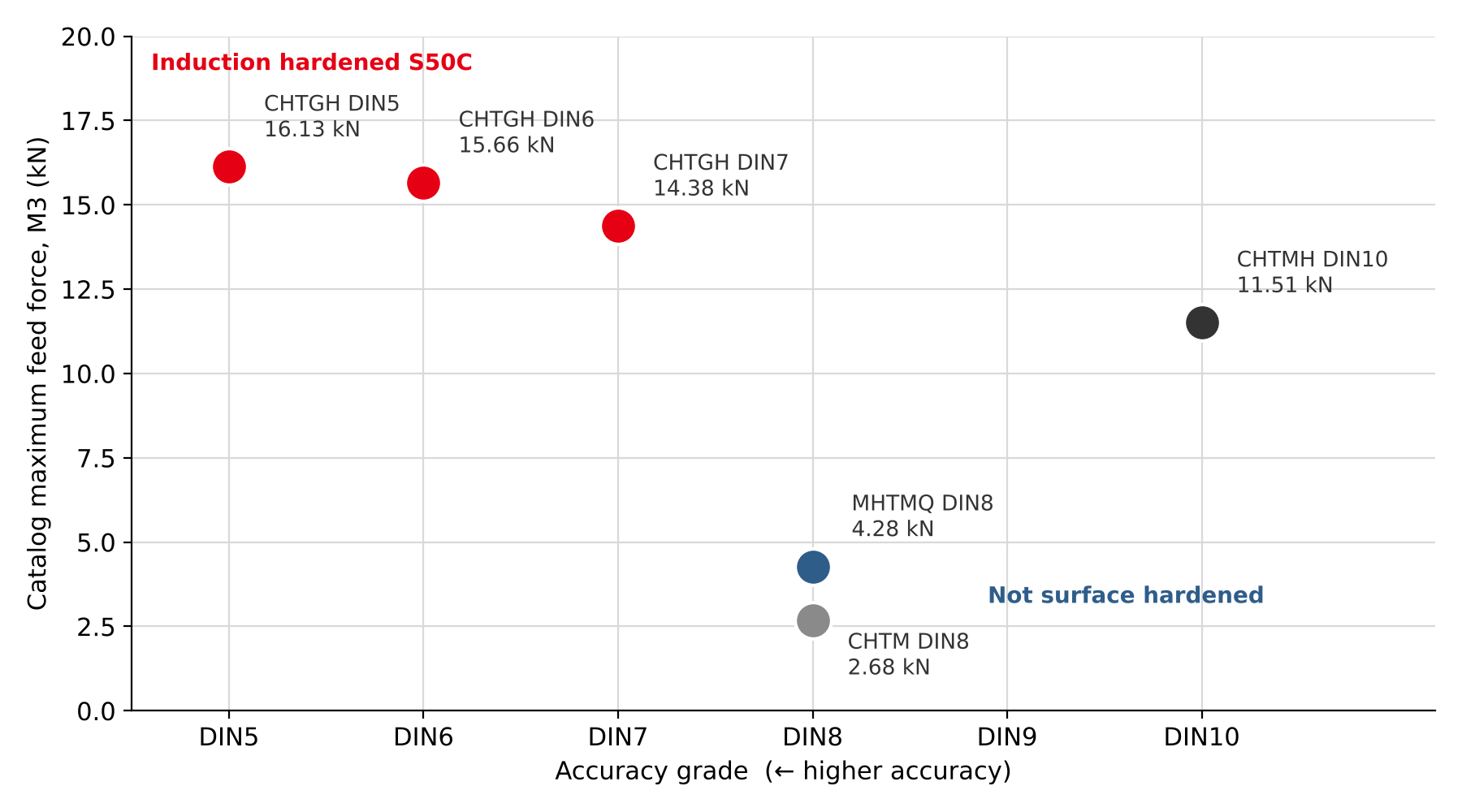
Plotted this way, the range splits into two groups. The induction-hardened grades sit high on load capacity across every accuracy grade. The two grades without surface hardening sit low, regardless of whether the steel is S50C or SCM440.
S50C (JIS G4051) is a medium carbon steel with about 0.47–0.53% carbon. That carbon level allows a high surface hardness after induction hardening, and the steel machines well before heat treatment.
SCM440 (JIS G4053) is a chromium-molybdenum alloy steel. Chromium and molybdenum raise its hardenability, meaning it hardens more deeply and uniformly in thick sections, and it gives a good balance of strength and toughness after quenching and tempering. It is widely used for shafts, bolts and gears.
Hardenability Is Not Hardness
Hardenability describes how deep a steel can be hardened; it says nothing about what hardness a particular part actually receives. SCM440 can be induction hardened to a high surface hardness as well: YYC’s ground pinions (MHGH, MSGH) are SCM440, induction hardened to HRC 50–55. What sets a rack’s load capacity is the heat-treatment route chosen, not the alloy name.
Induction hardening heats the teeth rapidly and quenches them, raising the tooth surface hardness to HRC 50–55. A hard tooth surface resists pitting and wear under repeated tooth contact, which is why these grades carry the highest feed force in the range.
Hardening causes some distortion. On the ground grades (CHTGH / CSTGH), the teeth are ground after hardening and the rack is ground on four faces, which removes that distortion and is what makes DIN 5–7 possible. The milled grades (CHTMH / CSTMH) keep the hardened, milled tooth and are graded DIN 10.
Quenching and tempering treats the whole bar, giving uniform properties of HRC 20–28 through the section; the teeth are then milled in this condition. With no hardened surface layer, contact load capacity and wear resistance are lower than for induction-hardened teeth.
The benefit is that the entire rack stays within a hardness range that standard tools can machine. That is useful when additional holes, end machining or fitting work are expected at assembly.
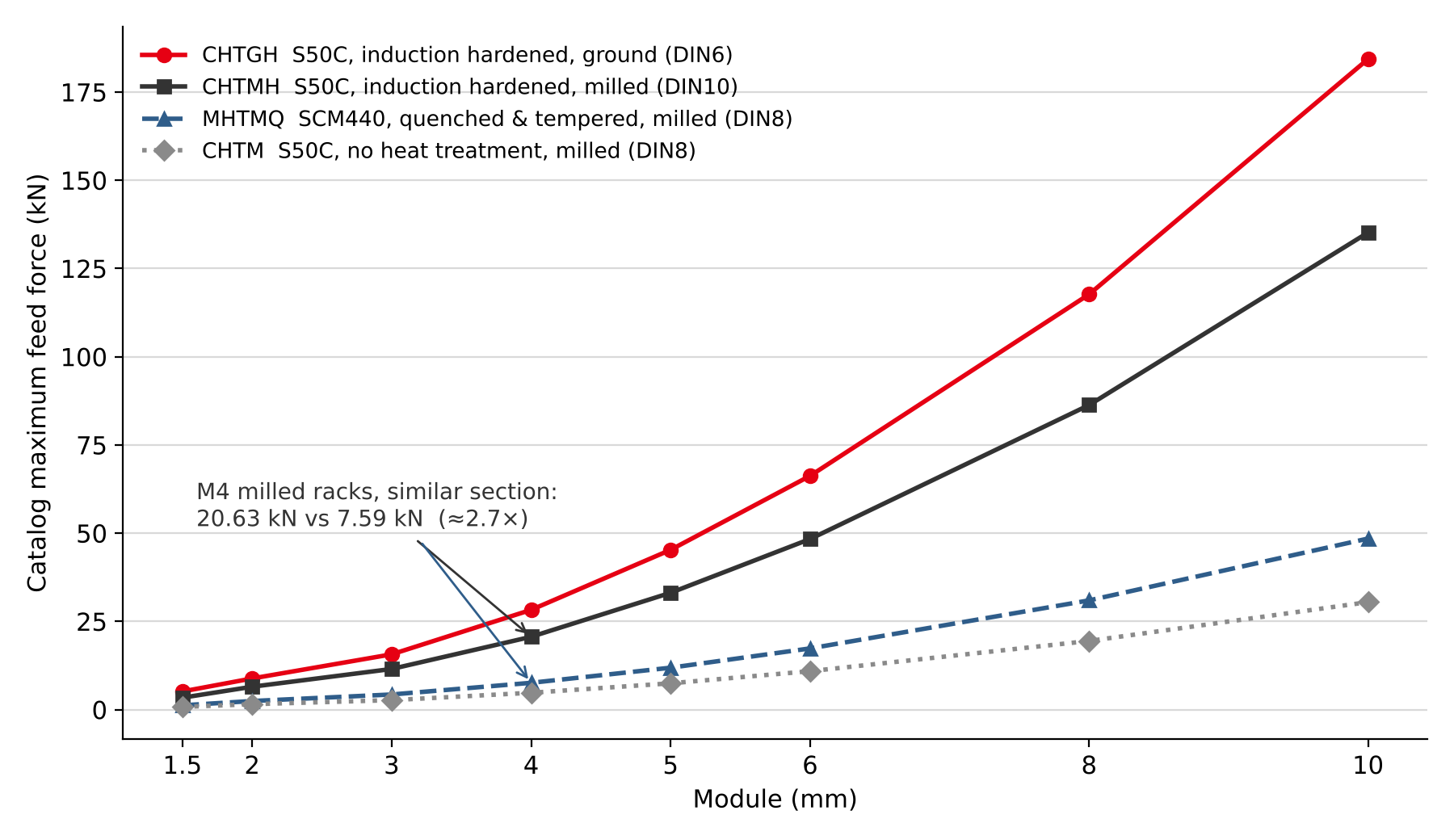
| Series (Helical, 1000 mm) | M2 | M3 | M4 | M6 | M10 |
|---|---|---|---|---|---|
| CHTGH, ground, DIN 6 | 8.82 | 15.66 | 28.26 | 66.24 | 184.35 |
| CHTMH, milled, DIN 10 | 6.48 | 11.51 | 20.63 | 48.34 | 135.18 |
| MHTMQ, Q&T SCM440, DIN 8 | 2.43 | 4.28 | 7.59 | 17.34 | 48.47 |
| CHTM, no heat treatment, DIN 8 | 1.53 | 2.68 | 4.77 | 10.89 | 30.46 |
Maximum feed force in kN. Source: YYC Rack & Pinion Catalogue 2026.
Three patterns stand out:
How to Read These Numbers
Catalog maximum feed force values are reference ratings for the listed rack under YYC’s standard rating conditions. The allowable force in a real machine also depends on the mating pinion, mounting accuracy, lubrication, speed and duty cycle, so selection should include a safety margin and be confirmed through YYC’s verification for the actual application.
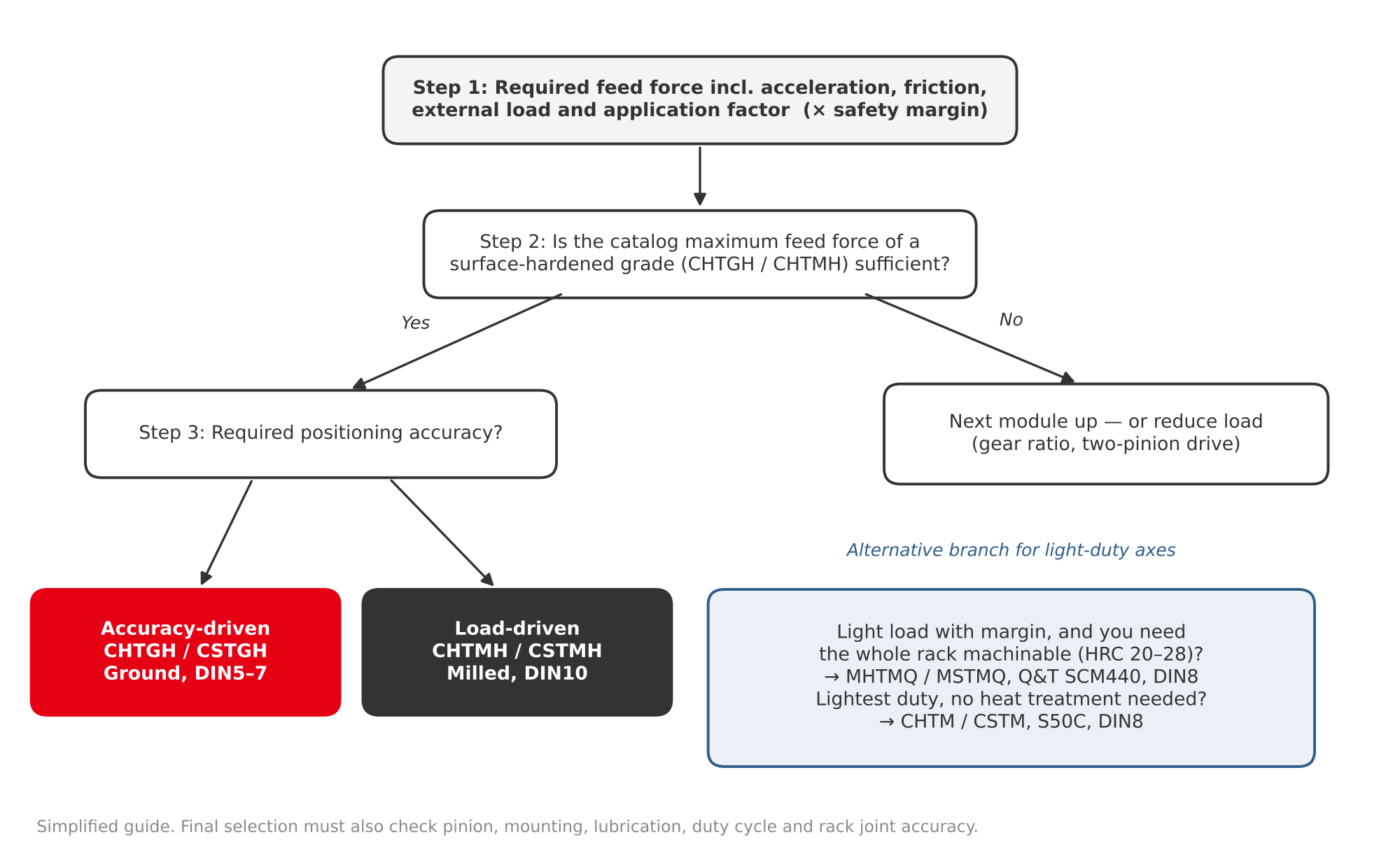
| Typical Application | What Drives the Choice | Starting Point |
|---|---|---|
| CNC laser, plasma and waterjet cutting machines, routers, high-dynamic gantries | Positioning accuracy plus repeated, high-acceleration loading | CHTGH / CSTGH, ground, DIN 5–7 |
| Heavy gantries, material handling, long-travel transfer axes | High feed force; positioning tolerance less critical | CHTMH / CSTMH, milled, DIN 10 (or CHTGH where accuracy also matters) |
| Light-load auxiliary axes and adjustment mechanisms | Modest load; rack may need machining at assembly | MHTMQ / MSTMQ, Q&T SCM440, DIN 8 |
| Very light-duty, low-cycle motion | Lowest load and cost | CHTM / CSTM, S50C, DIN 8 |
These are starting points, not a substitute for checking feed force, accuracy and the mating pinion for each machine.
In YYC’s standard range the opposite holds for rack load capacity: induction-hardened S50C is rated well above Q&T SCM440, because tooth surface hardness matters more than alloy content.
A softer tooth surface does not, by itself, make a drive more tolerant of shock; it lowers wear and contact capacity. Shock and impact are better handled by sizing the rack and pinion with an appropriate application factor and margin.
Accuracy comes from tooth finishing and inspection. Ground grades reach DIN 5–7; milled grades are DIN 8 or DIN 10. For multi-rack axes, accumulated pitch error also grows with the number of joints, so using fewer, longer racks helps.
Not on its own. Performance depends on heat treatment and tooth finish. In YYC’s catalog, induction-hardened S50C racks are rated for a higher maximum feed force than quenched-and-tempered SCM440 racks of the same module.
HRC 50–55 on the teeth, for both the ground (CHTGH / CSTGH) and milled (CHTMH / CSTMH) grades. Quenched-and-tempered SCM440 racks are HRC 20–28.
For lighter-duty axes where its catalog feed force covers the requirement with margin, particularly when the rack needs to be drilled or machined during assembly.
Within the same material and heat treatment, yes. At M4, the ground CHTGH DIN 6 is rated 28.26 kN and the milled CHTMH 20.63 kN.
Choose a gear rack by required feed force first, accuracy second, and material and heat treatment as the way to meet both. For most load-bearing axes, that points to induction-hardened S50C, ground where accuracy matters and milled where load dominates. Quenched-and-tempered SCM440 is the practical choice for lighter axes that benefit from a fully machinable rack.
Browse the full YYC gear rack range, or learn more about YYC Machinery.
Send us your required feed force, travel length, speed and accuracy requirement, and our engineers will recommend a rack and pinion combination.
Contact YYC Machinery